 FindMyNext
Sitting in the chair and saying “just a trim” is the fastest way to walk out with a cut you did not want. Barbers use a handful of names for most men’s cuts, and knowing them makes the conversation quick and clear. This guide explains the common UK cut names in plain words, then covers what to say, what to bring, and the mistakes to avoid.
Fades and tapers
Most short cuts start with the back and sides. The two words you will hear most are taper and fade.
- Taper: the hair gets gradually shorter from the top down to your natural hairline at the neck and sides. It does not go down to bare skin. It looks softer and grows out more gently.
- Fade: a very short taper that goes right down to the skin. The Art of Manliness puts it simply: all fades are tapers, but not all tapers are fades.
- Skin fade (or bald fade): any fade that blends down to bare skin. It gives a sharp, high-contrast look.
- Low fade: the fade starts low, close to the ear and neckline, so only a little skin shows.
- Mid fade: the fade starts just above the ear. It is more noticeable than a low fade.
- High fade: the fade starts high on the head, around the temples, so most of the back and sides are taken very short or to the skin. Some barbers call this a high and tight.
One word of warning: “taper fade” means different things to different people. FashionBeans and Modern Barber use it for a subtle fade that keeps a little hair at the neckline. The Art of Manliness says there is no such thing and that you should ask for one or the other. The safe way round this is to say whether you want skin showing at the bottom or not.
Short cuts
- Buzz cut: the same short length all over, done with clippers. It is low maintenance. You ask for it by grade, for example “a number 2 all over”.
- Crew cut: very short at the sides, a little longer on top, with slightly more length at the front.
- Crop: a short cut with the top pushed forward. A textured crop has the top cut choppy so it sits messy rather than flat.
- French crop: also called a Caesar cut. Short faded sides, a short top pushed forward, and a blunt, straight fringe. Modern Barber says it is one of the cuts younger clients ask for most. FashionBeans notes that leaving length in the fringe can help hide a receding hairline.
Longer tops and classic styles
- Textured top: the top is left longer and point cut (snipped into the ends with scissors) for movement. FashionBeans suggests asking the barber not to use thinning scissors on top, as they can leave the ends wispy.
- Quiff: volume at the front and top, styled up and back. It is a looser take on the pompadour. FashionBeans suggests deciding first whether you want softer short sides or tightly clippered sides.
- Side parting: a short back and sides with the top long enough to part. A hard part is a line shaved in to make the parting sharper. Your barber can help you find where your hair parts naturally.
- Mullet: short at the front and sides, longer at the back. Modern versions range from sharp and faded to soft and grown-out.
- Curtains: the 1990s look with a longer fringe parted in the middle (or slightly to the side) so it falls either side of the face. The back is kept short. Ape to Gentleman says the top and sides should be visibly disconnected rather than blended.
What to say and what to bring
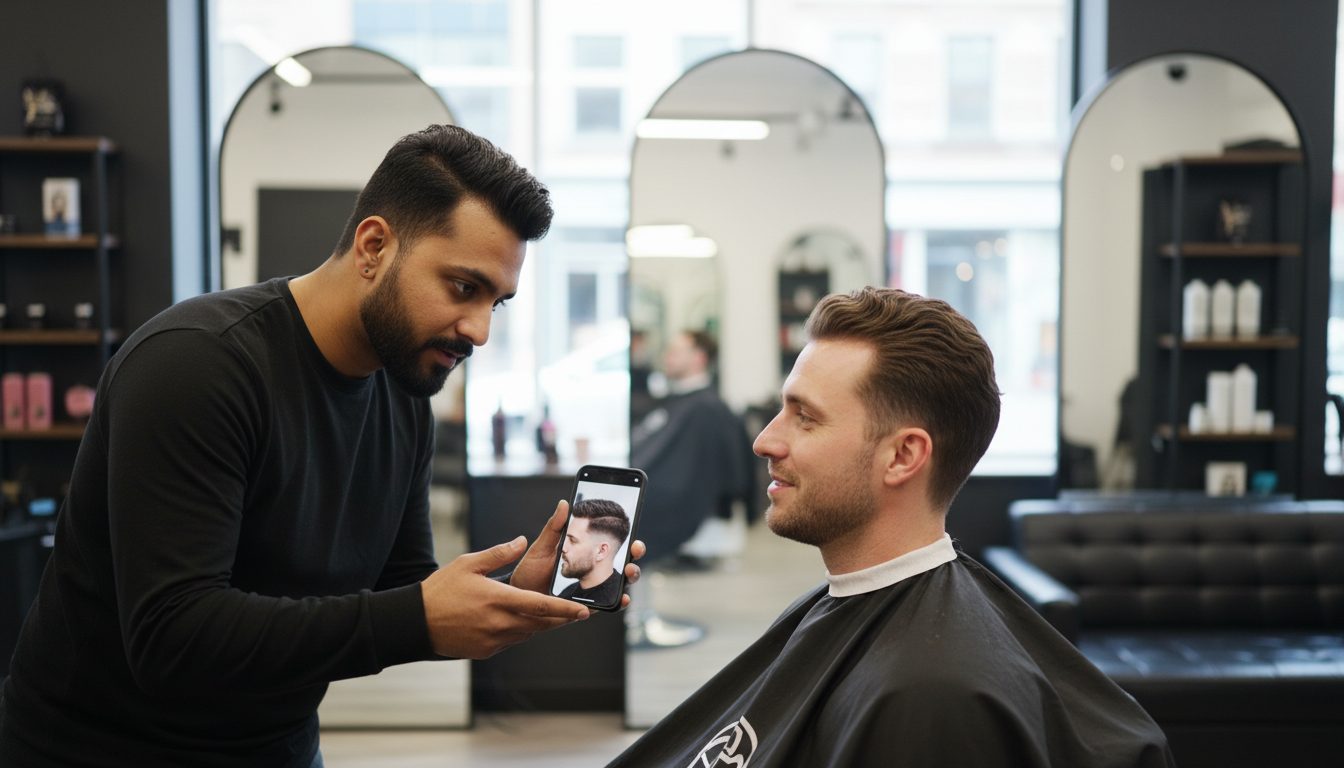
Bring photos. Most of the guides we read recommend this. A picture on your phone shows the barber the shape you want far better than words. Two or three photos are better than one: from the front, the side and the back if you can find them. Pick photos of someone whose hair type is close to yours.
Use guard numbers. For clipper work, say the grade for each area, such as “a 1 on the sides, blended into a 3, and scissors on top”. If you are not sure what the numbers mean, our clipper grades guide explains each one. If you are unsure, start longer. Your barber can always go shorter, but not the other way round.
Say how much to take off the top. Use your fingers or a rough measure, for example “about an inch off” or “leave enough to push back”. Short means different things to different barbers.
Mention your hair and your routine. Tell the barber about cowlicks, a double crown or thinning areas, and how much time you will spend styling it each morning. A cut that needs product and a hairdryer every day is no good if you will not use them.
The neckline
The neckline is the edge at the back of your neck. There are three common options:
- Tapered: follows your natural hairline and fades out. It grows out the neatest and needs the fewest touch-ups.
- Blocked (or squared): a straight line across the nape. It looks sharp at first but goes untidy quickly as it grows.
- Rounded: a blocked line with the corners softened. It also needs more regular tidying.
While you are at it, say how long you want your sideburns: top, middle or bottom of the ear.
Describing your beard
Treat the beard like the hair: give a length and a shape. Useful things to cover are:
- Length: a clipper grade (for example “a 3 all over”) or “just tidy the ends”.
- Neckline: Wahl suggests placing two fingers above your Adam’s apple; the top finger marks where the neckline should sit. Too high and the beard can look thin from the side.
- Cheek line: natural, or cleaned up with a sharp line. Wahl advises not to trim into the jawline itself.
- Blend: whether you want the sideburns faded into the beard to match the haircut.
Mistakes to avoid
- Being vague. “Just a trim” or “a little off the top” leaves the barber guessing.
- Going too short on the first visit. If you are trying a new barber or a new style, start a grade longer than you think.
- Asking for high, sharp arches around the ears. The Art of Manliness warns they can look odd as the hair grows back. Keeping your natural line usually works better.
- Ignoring advice. Some styles do not suit every hair type. A good barber will tell you, so listen.
- Not speaking up during the cut. If something looks wrong, say so early, while it can still be fixed.
Once you find a cut you like, note down exactly what was done. It makes the next visit easy. Short styles like skin fades also grow out quickly, so see our guide on how often to get a haircut.
Save your cut for next time
With a free FindMyNextBarber account, each haircut is saved with the style, notes and a photo, so you can show your barber exactly what you had last time. You can also check the live queue and join it from your phone, or book a time. The app is new, so there may be only a few shops listed near you at first.
Sources: The Art of Manliness, The difference between a taper and a fade; The Art of Manliness, How to talk to your barber; FashionBeans, Fade haircuts; FashionBeans, Classic men’s hairstyles; FashionBeans, Side part hairstyles; Modern Barber, Short haircuts to know right now; Modern Barber, French crop: everything you need to know; Pall Mall Barbers, Fade guide; Treatwell, The fade haircuts you should take to your barber; Ape to Gentleman, Middle part (curtains) hairstyles; Wahl, How to trim your beard neckline. Checked October 2026.